Julia Child Mastering the Art of French Cooking First Printing Edition
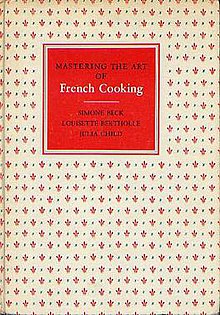 Cover of Book 1, original 1961 edition | |
| Author | Simone Beck, Louisette Bertholle, Julia Kid |
|---|---|
| Illustrator | Sidonie Coryn |
| Comprehend creative person | Paul Kidby |
| Country | United States/France |
| Language | English |
| Subject | Culinary arts |
| Genre | non-fiction |
| Publisher | Alfred A. Knopf |
| Publication date | 1961 (vol. one), 1970 (vol. 2) |
| Media type | book |
| Pages | 726 |
| ISBN | 0-375-41340-5 (40th anniversary edition) |
| OCLC | 429389109 |
| LC Class | TX719 .C454 2009 |
| Followed past | The French Chef Cookbook, Simca's Cuisine |
Mastering the Art of French Cooking is a ii-volume French cookbook written past Simone Brook and Louisette Bertholle, both from France, and Julia Child, who was from the United States.[i] The book was written for the American market and published by Knopf in 1961 (Volume 1) and 1970 (Volume 2). The success of Volume 1 resulted in Julia Child being given her own television prove, The French Chef, one of the first cooking programs on American television. Historian David Strauss claimed in 2011 that the publication of Mastering the Art of French Cooking "did more than any other event in the final one-half century to reshape the gourmet dining scene."[2]
History [edit]
Subsequently World War II, interest in French cuisine rose significantly in the United States.[3] Through the tardily 1940s and 1950s, Americans interested in preparing French dishes had few options. Gourmet mag offered French recipes to subscribers monthly, and several dozen French cookbooks were published throughout the 1950s. These recipes, however, were directly translated from French, and consequently were designed for a middle-form French audience that was familiar with French cooking techniques, had access to mutual French ingredients, and who ofttimes had servants melt for them.[4]
In the early 1950s, Simone Beck and Louisette Bertholle, French cooking teachers who had trained at Le Cordon Bleu, sought to capitalize on the American market for French cookbooks and wrote and published a small recipe book for American audiences, What'due south Cooking in France, in 1952. [5] By the late 1950s, Brook and Bertholle were interested in writing a comprehensive guide to French cuisine that would appeal to serious middle-form American abode cooks. Beck and Bertholle wanted an English-speaking partner to help requite them insight into American culture, interpret their piece of work into English, and bring it to American publishers, so they invited their friend Julia Child, who had besides studied at Le Cordon Bleu, to collaborate with them on a book tentatively titled "French Cooking for the American Kitchen".[6] [vii] The resulting cookbook, Mastering the Fine art of French Cooking, proved groundbreaking and has since get a standard guide for the culinary community.[viii]
Brook, Bertholle, and Child wanted to distinguish their book from others on the market past emphasizing accurate instructions and measurements in their recipes, and authenticity whenever possible. Afterward prototyping dishes in their Paris cooking school, L'École des trois gourmandes, Child would check to make sure the ingredients were available in the boilerplate American grocery shop; if they were not, she would suggest a exchange and they would brainstorm the prototyping process again with the substituted ingredient, sometimes flying in ingredients from America to perform their tests.[9] [x] While Beck, Bertholle, and Child wanted all of the recipes to be as authentic every bit possible, they were willing to adapt to American palates and cooking techniques. Kid had noted early on in the process that Americans would be "scared off" past too many expensive ingredients, like blackness truffles, and would expect broccoli, not particularly pop in France, to exist served with many meals, and adjustments were fabricated to accommodate these tastes.[11] American domicile cooks at the time were also more inclined to apply appliances like garlic presses and mixers than French cooks, and so Child insisted that supplemental instructions for cooks using these appliances be included in the book alongside the normal instructions.[12]
Mastering the Fine art of French Cooking Volume 1 was originally published in 1961 afterwards some early difficulties. Beck, Bertholle, and Child initially signed a contract with publisher Houghton Mifflin, simply Houghton Mifflin grew uninterested in the project. Child recalled one editor telling her, "Americans don't want an encyclopedia, they want to cook something quick, with a mix."[13] Beck, Bertholle, and Child refused to make requested changes to the manuscript, and Houghton Mifflin abased the project, writing that the book, equally information technology stood, would be "too formidable to the American housewife."[3] Judith Jones of Alfred A. Knopf became interested in the manuscript later on it had been rejected. After spending several years in Paris, Jones had moved to New York, where she grew frustrated with the limited ingredients and recipes normally bachelor in the Usa. Jones felt that the manuscript would offer a lifeline to middle-course women, like her, who were interested in learning how to cook French cuisine in America, and predicted that Mastering the Fine art of French Cooking, "will do for French cooking hither in America what Rombauer's The Joy of Cooking did for standard [American] cooking."[14] [xv] While Jones was enthusiastic nearly the book, Knopf had low expectations and invested very lilliputian into promoting it. In order to generate interest in the book, and without back up from Knopf, Child appeared on several morning time talk shows in 1961 to demonstrate recipes, which she later cited as the impetus for her own cooking testify, The French Chef.[16]
Book ane was immensely successful, and work on Volume ii began around 1964, equally a collaboration between Simone Beck and Julia Child, but not Louisette Bertholle. By the terminate of 1960, Beck and Child had grown frustrated with Bertholle considering they felt she did not contribute enough to Mastering the Art of French Cooking to merit co-authorship and ane 3rd of the volume'south proceeds, and wanted Knopf to alter the byline to read "by Simone Brook and Julia Child with Louisette Bertholle." Beck argued, "it is bad for the book for her to present herself as Author, as she really does not cook well enough, or know enough," and that Bertholle should only be entitled to 10% of the profits (to Beck and Child's 45% each). Ultimately, the contract with the publisher necessitated that Bertholle exist given a co-writer credit, and the final profit dissever was 18% to Bertholle and 41% each to Beck and Child. The dispute left Bertholle extremely upset, and effectively severed the professional partnership betwixt herself and Beck and Child.[7]
Book 2 expanded on certain topics of interest that had not been covered as completely as the three had planned in the first volume, particularly baking. In an otherwise laudatory review of Book 1, Craig Claiborne wrote that Brook, Bertholle, and Child had clearly omitted recipes for puff pastry and croissants, making their work feel incomplete.[17] Bread became one of the main focuses of Volume ii, and the chief source of tension between Beck and Child and their publisher, Knopf. Knopf feared that the bread recipes that Beck and Child were testing would exist stolen by a competing publisher, and insisted Brook and Child terminate their semi-public testing of the recipes to reduce risk, which Beck and Child agreed to reluctantly.[18]
Child became increasingly frustrated with the project equally work on Book 2 went on. Not but was she agitated by the demands of the publisher, she was growing tired of working with Beck, who she felt was likewise demanding.[5] Kid was also angry that, while Mastering the Art of French Cooking had been a runaway success in the U.s., there was virtually no demand for the book in France itself, leading her to exclaim, "French women don't know a damn thing about French cooking, although they pretend they know everything."[nineteen] Her experience writing Volume two, along with her continued success on television, led Child to sever her partnership with Beck and forestall the possibility of a Volume three, fifty-fifty though Beck, Bertholle, and Kid had always intended the work to span v volumes.[20]
Contents [edit]
Volume ane covers the nuts of French cooking, striking as much of a remainder between the complexities of haute cuisine and the practicalities of the American home cook. Traditional favorites such as beef bourguignon, bouillabaisse, and cassoulet are featured. This volume has been through many printings and has been reissued twice with revisions: first in 1983 with updates for changes in kitchen practice (especially the food processor), and then in 2003 as a 40th ceremony edition with the history of the volume in the introduction. The cookbook includes 524 recipes.[21]
Some archetype French blistering is also included, simply baking had already received a more thorough treatment in Volume 2, published in 1970.
Reception and legacy [edit]
Book 1 of Mastering the Art of French Cooking received overwhelmingly positive reviews when it was offset released in 1961. In the New York Times, Craig Claiborne wrote that the recipes in the book "are glorious, whether they are for a elementary egg in aspic or for a fish souffle," and that it "is not a book for those with a superficial involvement in food...but for those who take a fundamental please in the pleasures of cuisine."[17] Michael Field, writing for the New York Review of Books, praised Beck, Bertholle, and Child for "not limiting themselves to la haute cuisine," and stated that "for once, the architectural construction of the French cuisine is firmly and precisely outlined in American terms." Field's sole criticism of the book was that the authors suggested dry vermouth as a substitute for white wine, as he felt the domestic vermouth available to American home cooks, the volume's target audience, was "bland and characterless."[22] Despite being a relatively expensive cookbook, retailing for $ten in 1965, Mastering the Fine art of French Cooking Volume 1 did well commercially, selling over 100,000 copies in less than five years.[22] [5] According to Julia Kid biographer Noel Riley Fitch, the publication of Mastering the Art of French Cooking instantaneously inverse the unabridged American cookbook industry, leading more cookbook publishers to place accent on clarity and precision, and away from the "chatty and sometimes sketchy" style that had typified American cookbooks.[23]
On its release in 1970, Book two was also well received. Critics praised the book'south comprehensiveness, just some felt that it was far too ambitious for the boilerplate home cook. Gael Greene, reviewing the volume for Life, wrote that Volume 2 was "a classic continued," and made the contents of Volume 1 look like "mud-pie stuff," while Raymond Sokolov wrote that "it is without rival, the finest gourmet cookbook for the non-chef in the history of American stomachs."[24] [25] The New York Times' review was mixed, with critic Nika Hazelton praising the book for being "elegant and accurate," but criticized it for being too interested in minutia and theory to be useful for the abode cook. Learning French cooking from Mastering the Fine art of French Cooking, she wrote, would exist akin to "learning to bulldoze a car past having the workings of the internal combustion engine described in full detail."[25] Similarly, Nancy Ross of the Washington Post Times Herald argued that many of the recipes in Volume 2 would be far too time-consuming, difficult, and expensive for the American home cook, pointing out that the recipe for French bread provided in the book was nineteen pages long, took 7 hours to complete, and required the utilize of "a brick and a sheet of asbestos cement."[19]
The 2009 film, Julie & Julia, based on Child's memoir My Life in French republic and Julie Powell's memoir Julie and Julia: My Year of Cooking Dangerously. The success of this pic, combined with a tied-in reissue of the 40th Anniversary edition, caused information technology to again get a bestseller in the United States, 48 years after its initial release.[26]
Critical perception of Mastering the Art of French Cooking has generally remained positive. In 2015, The Daily Telegraph ranked it as the second greatest cookbook of all time, behind Fergus Henderson's Nose to Tail Eating.[27] In a 2012 New York Times piece commemorating Julia Child's 100th altogether, Julia Moskin wrote that Mastering the Art of French Cooking should be credited with "turning the tide" on American food civilization 1961, when "trends including feminism, food engineering science and fast food seemed fix to wipe out dwelling house cooking." Moskin added that, "in its central qualities, the volume and its many successors in the Child canon aren't dated at all. Their recipes remain perfectly written and rock-solid reliable."[28] By contrast, in 2009, food writer Regina Schrambling published a piece in Slate entitled, "Don't Buy Julia Child's Mastering the Art of French Cooking," where she argued that the book now "seems overwhelming in a Rachael Ray world," its recipes overly complicated and unsuited for modern American tastes.[29]
Come across also [edit]
- La bonne cuisine de Madame Due east. Saint-Ange
- Julie & Julia
- The Joy of Cooking
- Larousse Gastronomique
- Pellegrino Artusi
References [edit]
- ^ Maçek, J.C., Iii (2012-08-xiii). "Bless This Mess: Sweeping the Kitchen with Julia Child". PopMatters.
- ^ Strauss, David (2011). Setting the Table for Julia Kid: Gourmet Dining in America, 1934-1961. Baltimore: The Johns Hopkins University Press. p. 221. ISBN978-0801897733.
- ^ a b Reardon, Joan (Summer 2005). "Mastering the Art of French Cooking: A About Classic or a Most Miss". Gastronomica. 5 (3): 65. doi:ten.1525/gfc.2005.5.3.62. JSTOR 10.1525/gfc.2005.5.iii.62.
- ^ Strauss, David (2011). Setting the Table for Julia Child: Gourmet Dining in America, 1934-1961. Baltimore: The Johns Hopkins University Press. pp. 221–222. ISBN978-0801897733.
- ^ a b c Reardon, Joan (Summer 2005). "Mastering the Art of French Cooking: A Near Classic or a Nearly Miss". Gastronomica. v (3): 62–72. doi:10.1525/gfc.2005.5.3.62. JSTOR 10.1525/gfc.2005.5.iii.62.
- ^ Reardon, Joan (Summer 2005). "Mastering the Art of French Cooking: A Virtually Classic or a Well-nigh Miss". Gastronomica. 5 (three): 62–72. doi:10.1525/gfc.2005.5.3.62. JSTOR ten.1525/gfc.2005.v.3.62.
- ^ a b Fitch, Noel Riley (1999). Appetite for Life: The Biography of Julia Child. New York: Anchor Books. p. 221. ISBN0307948382.
- ^ "Julia Child'south Cookbooks". AbeBooks.com.
Julia Kid can be thanked for introducing French cuisine to America - the land of hot dogs and apple pie - during the 1960s.
- ^ Strauss, David (2011). Setting the Tabular array for Julia Child: Gourmet Dining in America, 1934-1961. Baltimore: The Johns Hopkins University Press. p. 233. ISBN978-0801897733.
- ^ Fitch, Noel Riley (1999). Appetite for Life: The Biography of Julia Kid. New York: Ballast Books. pp. 212–213. ISBN0307948382.
- ^ Kid, Julia (2006). My Life in France. New York: Alfred A. Knopf. p. 207. ISBN0307277690.
- ^ Strauss, David (2011). Setting the Table for Julia Child: Gourmet Dining in America, 1934-1961. Baltimore: The Johns Hopkins University Press. p. 232. ISBN978-0801897733.
- ^ Child, Julia; Prud'homme, Alex (2006). My Life in French republic. New York: Alfred A. Knopf. p. 209. ISBN0307264726.
- ^ Steel, Tanya. "A Conversation with Judith Jones". Epicurious. Conde Nast. Retrieved April two, 2016.
- ^ Fitch, Noel Riley (1999). Appetite for Life: The Biography of Julia Child. New York: Ballast Books. p. 263. ISBN0307948382.
- ^ Reardon, Joan (Summer 2005). "Mastering the Art of French Cooking: A Virtually Classic or a Near Miss". Gastronomica. five (3): 69. doi:ten.1525/gfc.2005.5.three.62. JSTOR 10.1525/gfc.2005.5.3.62.
- ^ a b Claiborne, Craig (October xviii, 1961). "Cookbook Review: Glorious Recipes" (PDF). The New York Times . Retrieved March 29, 2018.
- ^ Fitch, Noel Riley (1999). Ambition for Life: The Biography of Julia Child. New York: Anchor Books. p. 345. ISBN0307948382.
- ^ a b Ross, Nancy L. (Nov 5, 1970). "Mastering Julia's French Recips: Mastering the Recipes". The Washington Post Times Herald. ProQuest 147801739.
- ^ Reardon, Joan (Summer 2005). "Mastering the Art of French Cooking: A Nearly Classic or a About Miss". Gastronomica. 5 (three): 64, 71. doi:x.1525/gfc.2005.five.iii.62. JSTOR ten.1525/gfc.2005.5.3.62.
- ^ "Book page for Mastering the Art of French Cooking", Amazon.com, ISBN0375413405
- ^ a b Field, Michael (Nov 25, 1965). "The French Mode". The New York Review of Books . Retrieved April 2, 2018.
- ^ Fitch, Noel Riley (1999). Appetite for Life: The Biography of Julia Kid. New York: Anchor Books. p. 275. ISBN0307948382.
- ^ Greene, Gael (October 23, 1970). "Life". p. viii. Retrieved April 2, 2018.
- ^ a b Fitch, Noel Riley (1999). Appetite for Life: The Biography of Julia Kid. New York: Ballast Books. p. 361. ISBN9781441744548.
- ^ Clifford, Stephanie (23 Baronial 2009). "Subsequently 48 Years, Julia Kid Has a Big Best Seller, Butter and All". The New York Times . Retrieved ix May 2012.
- ^ Langbein, Annabel (December 12, 2015). "25 greatest cookbooks of all time". The Daily Telegraph . Retrieved March 25, 2018.
- ^ Moskin, Julia (Baronial fourteen, 2012). "The Gifts She Gave". The New York Times . Retrieved March 22, 2018.
- ^ Schrambling, Regina (August 28, 2009). "Don't Buy Julia Child's Mastering the Fine art of French Cooking". Slate . Retrieved March 25, 2018.
External links [edit]
- PBS
Source: https://en.wikipedia.org/wiki/Mastering_the_Art_of_French_Cooking
0 Response to "Julia Child Mastering the Art of French Cooking First Printing Edition"
Post a Comment